
Sleep, Recovery and the Nervous System
Sleep is often discussed as though it were simply a period of rest. In reality, sleep is an active physiological state during which substantial changes occur across neural, autonomic, endocrine, metabolic and immune systems. The organisation and continuity of sleep contribute to physiological regulation and the maintenance of processes involved in cognition, emotional regulation and sensory processing.
For people living with persistent pain, sleep disturbance is particularly common. More importantly, the relationship between sleep and pain appears to operate in both directions. Pain can interfere with sleep, while disturbed sleep can subsequently influence pain sensitivity and the mechanisms through which the nervous system regulates nociceptive information (Finan et al., 2013; Runge et al., 2024).
Recent prospective evidence reinforces this relationship. A systematic review and meta-analysis incorporating 16 articles from 11 study populations and 116,746 participants found that pre-existing sleep problems were associated with an increased risk of developing chronic musculoskeletal pain in both shorter- and longer-term follow-up. Chronic musculoskeletal pain also appeared to increase the subsequent likelihood of sleep problems over shorter periods, although the evidence supporting the reverse direction was less certain (Runge et al., 2024).
Understanding this interaction may therefore be particularly important when recovery becomes prolonged or when symptoms continue after the original tissue injury has substantially resolved.
Sleep Is an Active Biological Process
Normal sleep is organised into recurring stages of non-rapid eye movement (NREM) and rapid eye movement (REM) sleep. These stages are associated with differing patterns of neural and autonomic activity and contribute to multiple aspects of physiological regulation.
Consequently, sleep cannot necessarily be understood simply by counting the number of hours spent in bed. Sleep continuity, timing and fragmentation can also influence how restorative sleep is experienced.
This distinction is clinically relevant because an individual may spend an apparently adequate number of hours asleep while experiencing frequent arousals or disrupted sleep architecture.
Research examining pain and sleep supports the importance of sleep continuity. Alterations in sleep continuity and architecture have been associated with changes in endogenous pain-inhibitory processes, suggesting that the organisation of sleep itself may influence pain regulation rather than sleep duration being the only relevant variable (Edwards et al., 2009).
Figure 1
Key brain regions involved in sleep regulation
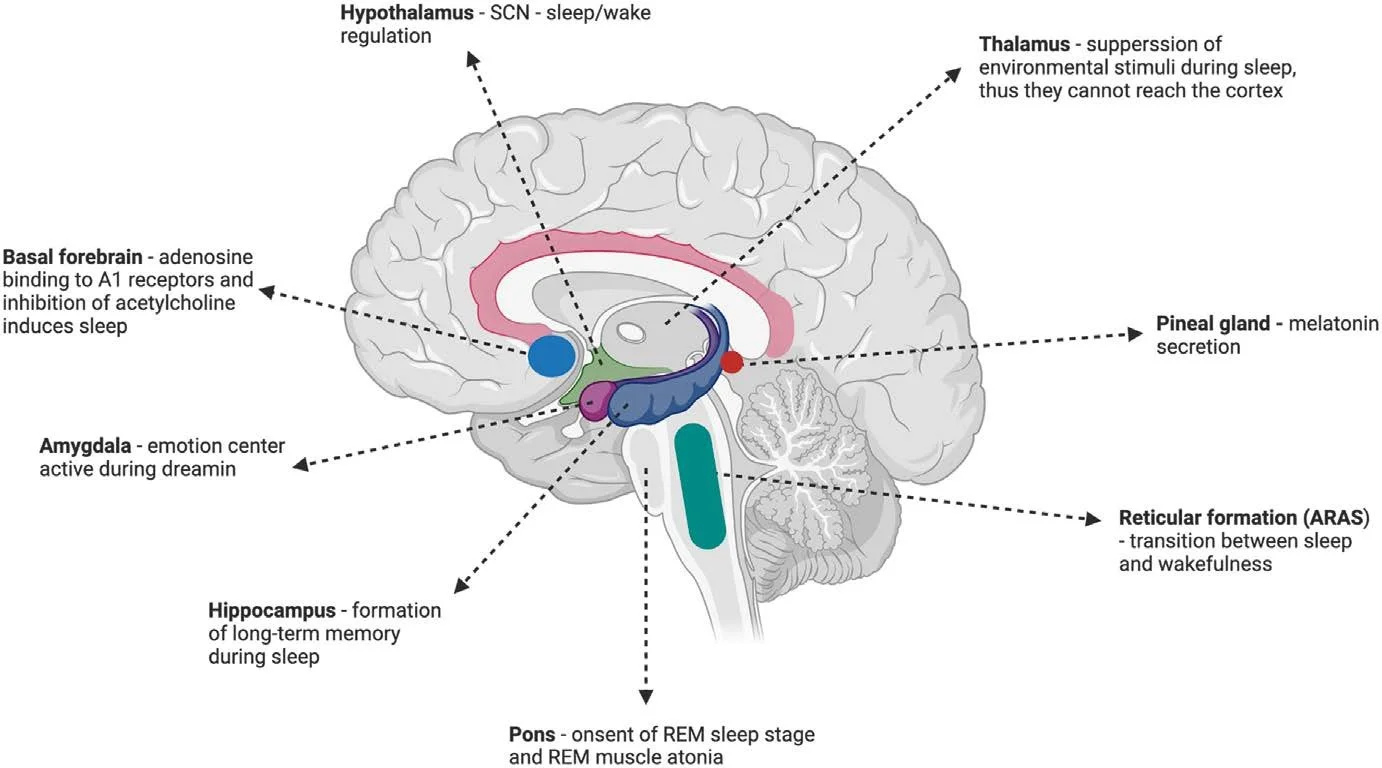
Note. From Sleep Science Made Simple: A Clear and Concise Guide (pp. 34), by Juginović, A., 2025, Springer Nature Switzerland.The Relationship Between Sleep and Pain
Persistent pain frequently interferes with sleep. Painful positions, difficulty finding a comfortable posture, medication effects, psychological distress, altered breathing during sleep, or other medical conditions may all contribute to difficulty falling asleep or remaining asleep.
However, the relationship also operates in the opposite direction. A substantial body of experimental and longitudinal research indicates that sleep disturbance can increase pain sensitivity and influence endogenous pain-modulatory systems (Finan et al., 2013; Haack et al., 2012; Schrimpf et al., 2015).
For example, Haack et al. (2012) compared individuals with primary insomnia with matched healthy controls. Participants with insomnia demonstrated lower heat-pain thresholds and reduced endogenous pain inhibition. These observations suggest that persistent sleep disturbance may be associated not simply with fatigue but with measurable differences in the way nociceptive information is processed and regulated.
Experimental sleep deprivation provides further evidence. Staffe et al. (2019) found that a single night of total sleep deprivation increased pressure and cold pain sensitivity, increased temporal summation of pain and impaired conditioned pain modulation in healthy participants.
These findings are important because conditioned pain modulation reflects, at least in part, the capacity of endogenous nervous-system mechanisms to inhibit nociceptive signalling. This does not mean that pain occurring after poor sleep is psychological or imagined. Rather, the physiological state of the nervous system can influence how incoming nociceptive information is processed.
Pain Is Not Determined by Tissue Damage Alone
Pain is a complex protective experience that cannot be inferred directly from the extent of structural tissue damage. Nociceptive information arising from tissues contributes substantially to pain, particularly during acute injury. However, pain ultimately emerges from neural processing that integrates nociceptive input with multiple contextual and physiological influences. These can include previous experience, attention, expectation, emotional state, fatigue, sleep, autonomic activity and the broader biological environment.
Sleep forms part of this environment. Experimental studies demonstrate that manipulating sleep can alter pain responses even in otherwise healthy individuals. A meta-analysis of experimental sleep-deprivation studies concluded that sleep deprivation significantly increases pain perception across a range of experimental paradigms (Schrimpf et al., 2015).
Consequently, the same physical load or stimulus may be experienced differently following restorative sleep compared with a period of substantial sleep disruption. This does not necessarily mean that the tissue has become more damaged. It means that the physiological context in which sensory information is being processed has changed.
Sleep and Endogenous Pain Regulation
The nervous system contains multiple mechanisms capable of amplifying or inhibiting nociceptive signalling. One clinically relevant experimental measure is conditioned pain modulation, which describes the reduction in the perception of one painful stimulus when another noxious conditioning stimulus is applied elsewhere in the body. Although conditioned pain modulation does not represent the entirety of descending pain control, it provides an experimental window into endogenous pain-inhibitory function.
Sleep disruption appears capable of altering this system. In a controlled experimental study, Smith et al. (2007) demonstrated that selective sleep disruption was associated with impaired pain inhibition and increased spontaneous pain in healthy women. Subsequent research has provided further evidence that sleep deprivation can impair conditioned pain modulation and facilitate temporal summation of pain (Staffe et al., 2019).
Taken together, these findings suggest that inadequate sleep can alter both inhibitory and facilitatory aspects of nociceptive processing. This provides one plausible neurophysiological explanation for why people experiencing prolonged sleep disturbance may become more sensitive to otherwise tolerable physical stimuli.
The Nervous System and Physiological Alertness
Sleep also involves substantial changes in autonomic nervous-system activity. Heart rate, blood pressure, respiration and cardiovascular autonomic control vary systematically across wakefulness, NREM sleep and REM sleep.
Insomnia has frequently been conceptualised partly as a disorder of hyperarousal, in which cognitive, cortical or physiological activation remains elevated when the nervous system would ordinarily transition toward sleep. However, this concept requires some qualification. Recent reviews indicate strong evidence for cognitive and cortical hyperarousal in insomnia, while findings concerning specific autonomic measures such as resting heart rate and heart-rate variability remain more heterogeneous (Dressle & Riemann, 2023). It is therefore more accurate to describe hyperarousal as a multidimensional phenomenon rather than assuming that every person with insomnia demonstrates a uniform state of sympathetic overactivity.
Clinically, however, some patients describe a recognisable experience: they feel physically fatigued while simultaneously finding it difficult to disengage, relax or maintain continuous sleep. In such circumstances, simply advising someone to “get more sleep” may not adequately address the factors interfering with sleep. The more relevant question may be what is preventing sleep from becoming consolidated and restorative.
Sleep, Stress and Recovery Capacity
Sleep, stress and pain are not isolated physiological domains. They interact through overlapping neural, endocrine and behavioural systems. Periods of illness, psychological stress, altered physical loading, persistent pain or major disruption to daily routine can interfere with sleep. Conversely, sleep disruption can influence sensory processing, emotional regulation and the capacity to tolerate physical and psychological demands. This interaction may help explain why persistent pain can fluctuate considerably in the absence of new tissue damage.
Someone may tolerate a physical activity well following several nights of restorative sleep yet experience substantially greater discomfort performing a similar activity following repeated sleep disruption. The activity itself may not have become more damaging. Rather, the physiological context surrounding the activity has changed. For persistent pain, this distinction can be important because symptom intensity and structural pathology are not always closely correlated.
Circadian Rhythm Matters
Sleep is also governed by circadian biology. The human circadian timing system coordinates physiological processes across approximately 24 hours and contributes to the regulation of sleep and wakefulness, endocrine function, body temperature, metabolism and behavioural activity.
Pain sensitivity itself also appears to possess a circadian component. In a highly controlled laboratory study, Daguet et al. (2022) demonstrated that pain sensitivity varied systematically over the 24-hour period. Mathematical modelling suggested that the endogenous circadian system accounted for considerably more of this variation than accumulating sleep pressure alone. Pain sensitivity peaked during the biological night and was lowest during the afternoon under the experimental conditions used. This is a particularly interesting finding because it demonstrates that pain sensitivity is not physiologically constant throughout the day.
The timing of symptoms can therefore sometimes provide clinically useful information. Regular light exposure, sleep-wake timing, activity patterns and behavioural schedules all contribute to the organisation of circadian rhythms. Disturbance of these rhythms may therefore influence both sleep and broader physiological regulation. For this reason, improving sleep sometimes requires consideration of the entire 24-hour pattern rather than focusing solely on what occurs immediately before bedtime.
Recovery Is More Than Tissue Healing
A purely structural model of recovery assumes that symptoms should resolve once injured tissues have healed. Frequently, they do. But this is not always the case.
For some people, altered nociceptive processing, reduced physical capacity, sleep disturbance, fear of movement, changes in physical activity and persistent physiological stress can remain after the original tissue injury has substantially recovered.
Sleep disturbance does not need to be considered the singular cause of persistent pain for it to be clinically important. Indeed, the contemporary literature suggests that sleep may function as one of several interacting modulators capable of influencing pain sensitivity and the persistence of musculoskeletal symptoms. Finan et al. (2013), reviewing longitudinal and experimental evidence, observed that sleep impairment frequently predicts subsequent increases in pain and the development or exacerbation of chronic pain. More recent meta-analytic findings support that conclusion, while also emphasising that the magnitude and direction of the relationship vary between populations and types of sleep disturbance (Runge et al., 2024).
Recovery may therefore require attention to more than the anatomical site at which pain is experienced. Improving physical capacity, gradually restoring activity, addressing relevant sleep problems and identifying other physiological or medical contributors may collectively create a more favourable environment for recovery.
There Is No Single Sleep Solution
Sleep disturbance has many possible causes. Pain itself may contribute. In other people, insomnia, obstructive sleep apnoea, restless legs syndrome, circadian rhythm disorders, medication effects, mood disorders, hormonal factors or other medical conditions may be important. For that reason, sleep difficulty should not automatically be treated as a behavioural problem. Persistent snoring, witnessed pauses in breathing, substantial daytime sleepiness, abnormal movements during sleep or longstanding insomnia may warrant appropriate medical investigation.
Likewise, there is no single “sleep hygiene” intervention that addresses every form of disturbed sleep. The first objective is to understand the pattern.
Is the difficulty primarily falling asleep, maintaining sleep or waking prematurely?
Does pain cause the waking, or is pain noticed after waking?
Does the person wake refreshed?
Is sleep substantially different between working days and non-working days?
Are symptoms associated with particular times of the night or morning?
These distinctions can help determine whether the problem is primarily behavioural, physiological, circadian, pain-related or potentially indicative of a recognised sleep disorder.
Looking at the Whole Recovery Environment
When I assess someone experiencing persistent pain, sleep forms one component of a much broader clinical picture.
I am interested not only in where a person experiences pain, but also in how their symptoms behave over 24 hours, how they respond to activity, how they recover from physical loading, the quality and continuity of their sleep, and whether additional investigation may be required.
The purpose is not to attribute every symptom to sleep or to the nervous system. It is to understand how the systems influencing recovery may be interacting. For some people, improving sleep may make rehabilitation easier. For others, increasing daytime activity, restoring physical capacity, addressing pain-related apprehension or investigating an underlying sleep disorder may indirectly improve sleep. The relationship is often reciprocal.
A Broader View of Recovery
Sleep should therefore be considered part of the physiological environment in which recovery occurs. Experimental studies demonstrate that acute sleep loss can increase pain sensitivity and alter endogenous pain regulation, while prospective population research suggests that persistent sleep problems increase the subsequent likelihood of chronic musculoskeletal pain (Runge et al., 2024; Staffe et al., 2019).
This does not mean that improving sleep will automatically eliminate persistent pain. Nor does it mean that persistent pain is simply caused by inadequate sleep. Rather, sleep represents one biologically plausible and scientifically supported influence on how the nervous system regulates sensory information and adapts to physical and psychological demands.
For people experiencing persistent pain, the question may therefore need to extend beyond:
“Where is the pain coming from?”
to include:
“What factors are influencing the body's capacity to recover?”
With kind regards,
Dr. Kevin Ivins
References
Daguet, I., Raverot, V., Bouhassira, D., & Gronfier, C. (2022). Circadian rhythmicity of pain sensitivity in humans. Brain : a journal of neurology, 145(9), 3225–3235. https://doi.org/10.1093/brain/awac147
Edwards, R. R., Grace, E., Peterson, S., Klick, B., Haythornthwaite, J. A., & Smith, M. T. (2009). Sleep continuity and architecture: associations with pain-inhibitory processes in patients with temporomandibular joint disorder. European journal of pain (London, England), 13(10), 1043–1047. https://doi.org/10.1016/j.ejpain.2008.12.007
Finan, P. H., Goodin, B. R., & Smith, M. T. (2013). The association of sleep and pain: an update and a path forward. The journal of pain, 14(12), 1539–1552. https://doi.org/10.1016/j.jpain.2013.08.007
Haack, M., Scott-Sutherland, J., Santangelo, G., Simpson, N. S., Sethna, N., & Mullington, J. M. (2012). Pain sensitivity and modulation in primary insomnia. European journal of pain (London, England), 16(4), 522–533. https://doi.org/10.1016/j.ejpain.2011.07.007
Juginović, A. (2025). Inside the Sleeping Brain: From Chemistry to Dreams. In Sleep Science Made Simple: A Clear and Concise Guide (pp. 33-49). Cham: Springer Nature Switzerland.
Runge, N., Ahmed, I., Saueressig, T., Perea, J., Labie, C., Mairesse, O., Nijs, J., Malfliet, A., Verschueren, S., Van Assche, D., de Vlam, K., Van Waeyenberg, T., Van Haute, J., & De Baets, L. (2024). The bidirectional relationship between sleep problems and chronic musculoskeletal pain: a systematic review with meta-analysis. Pain, 165(11), 2455–2467. https://doi.org/10.1097/j.pain.0000000000003279
Schrimpf, M., Liegl, G., Boeckle, M., Leitner, A., Geisler, P., & Pieh, C. (2015). The effect of sleep deprivation on pain perception in healthy subjects: a meta-analysis. Sleep medicine, 16(11), 1313–1320. https://doi.org/10.1016/j.sleep.2015.07.022
Smith, M. T., Edwards, R. R., McCann, U. D., & Haythornthwaite, J. A. (2007). The effects of sleep deprivation on pain inhibition and spontaneous pain in women. Sleep, 30(4), 494–505. https://doi.org/10.1093/sleep/30.4.494
Staffe, A. T., Bech, M. W., Clemmensen, S. L. K., Nielsen, H. T., Larsen, D. B., & Petersen, K. K. (2019). Total sleep deprivation increases pain sensitivity, impairs conditioned pain modulation and facilitates temporal summation of pain in healthy participants. PloS one, 14(12), e0225849. https://doi.org/10.1371/journal.pone.0225849
