
Persistent headaches, facial pain, discomfort around the eyes or unexplained sensations involving the jaw and teeth can significantly affect a person's quality of life. For some individuals, these symptoms recur despite treatment, while others undergo extensive investigations without receiving a clear explanation for their discomfort.
Although pain is experienced in a particular region of the head or face, the neurological mechanisms responsible may involve several interconnected structures within the peripheral and central nervous systems. Understanding these relationships is an important part of determining why pain develops, how it is maintained and which approaches to management may be appropriate. One particularly important component of this system is the trigeminal nerve, whose sensory pathways interact with structures responsible for processing pain arising from the head, face and upper cervical region.
The Trigeminal Nerve and Its Role in Pain
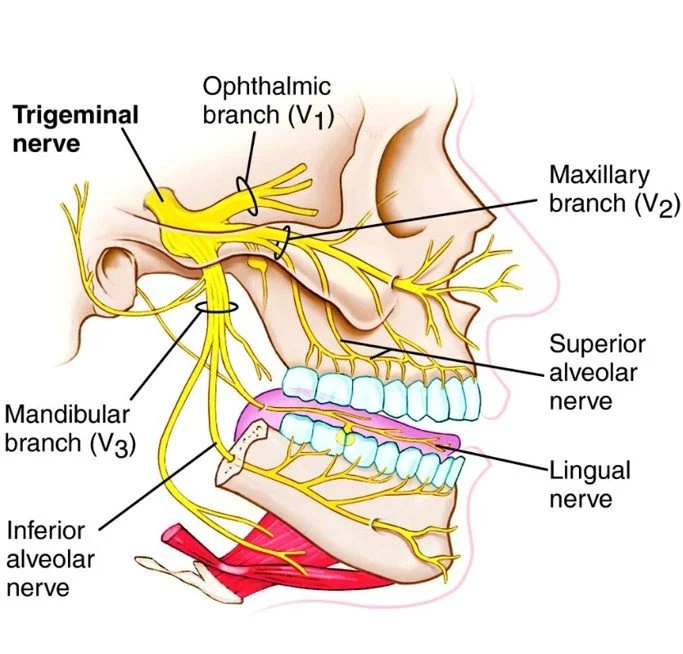
The trigeminal nerve, also known as the fifth cranial nerve, provides the principal sensory innervation of the face. Its three divisions transmit sensory information from the forehead and eyes, cheeks and upper jaw, and lower jaw. Beyond ordinary touch, the trigeminal system contributes to the transmission of pain and temperature information from numerous craniofacial structures, including the cornea, nasal passages, teeth, oral cavity and portions of the cranial meninges. Disturbances affecting these sensory pathways may contribute to facial pain, altered sensation, burning discomfort or increased sensitivity to ordinarily non-painful stimulation.
One recognised condition is trigeminal neuralgia, characterised by recurrent episodes of intense, electric shock-like facial pain, generally affecting one side of the face. However, facial pain is not necessarily evidence of trigeminal neuralgia. Dental disorders, temporomandibular conditions, inflammatory processes, other neuropathic disorders and referred pain can produce overlapping symptoms (Bendtsen et al., 2019). Distinguishing between these conditions requires an understanding of the underlying neurological mechanisms rather than relying exclusively on the anatomical location of pain.
Figure 1
The Trigeminal Nerve (V)
Understanding the Differences Between Headache Disorders
Although headaches are frequently described according to their location or intensity, their underlying mechanisms can differ considerably. This distinction is particularly important because different headache disorders may produce similar symptoms while requiring different approaches to investigation and management.
Migraine is a neurological disorder involving altered sensory processing and activation of trigeminovascular pathways. Episodes commonly involve moderate to severe headache, nausea and increased sensitivity to light or sound. Neck discomfort may also accompany migraine, although this does not necessarily indicate that the cervical spine is responsible for the headache.
Tension-type headache generally presents as a bilateral pressing or tightening sensation, often described as a band around the head. Pain is usually mild to moderate and is not typically aggravated by routine physical activity. In persistent presentations, altered central pain processing and increased pericranial tenderness may contribute to the clinical picture.
Cervicogenic headache occurs when pain is attributable to a disorder involving structures of the cervical spine. Symptoms may extend from the upper neck or occipital region towards the forehead, temple or eye. Restricted neck movement or reproduction of familiar symptoms during cervical examination may provide useful clinical information, although these findings alone do not establish the diagnosis.
Cluster headache is a distinct neurological disorder characterised by episodes of extremely severe, predominantly unilateral pain around the eye or temple. Attacks commonly involve associated autonomic symptoms, including tearing, nasal congestion, eyelid changes or facial sweating. These symptoms arise through interactions involving trigeminal-autonomic pathways and central neurological mechanisms.
The International Classification of Headache Disorders provides established diagnostic criteria for differentiating these presentations (Headache Classification Committee of the International Headache Society, 2018).
The Trigeminocervical Complex: Why Pain Can Be Experienced Away From Its Source
One of the more significant features of craniofacial pain processing is the convergence of sensory information from the trigeminal nerve and the upper cervical spinal nerves. This interaction occurs within a region known as the trigeminocervical complex, which incorporates the spinal trigeminal nucleus caudalis and the upper cervical dorsal horn. Within these neural structures, nociceptive signals arising from the face, cranial tissues and upper cervical region may converge upon shared neurons.
Consequently, the central nervous system may interpret nociceptive information from one anatomical region as pain occurring elsewhere. For example, sensory activity originating in certain upper cervical structures may contribute to pain experienced around the forehead, temple or eye. This phenomenon provides an important neurophysiological explanation for some forms of referred craniofacial pain (Bartsch & Goadsby, 2003). Importantly, recognising this relationship does not mean that all headaches or facial pain originate from the neck. Rather, it demonstrates how interconnected sensory pathways may influence the distribution and perception of pain.
Why Pain May Continue Even When Structural Investigations Are Unremarkable
An important consideration in persistent pain management is that the severity of pain does not always correspond directly with the extent of identifiable tissue pathology. The nervous system continually processes sensory information through complex interactions between peripheral receptors, spinal and brainstem circuits, ascending pathways and descending pain-modulatory systems. In some circumstances, sustained nociceptive input or changes in neuronal responsiveness may increase sensitivity within these systems. This process, often discussed in relation to central sensitisation, can contribute to amplified pain responses, increased sensitivity to stimulation and pain extending beyond its original distribution.
However, central sensitisation is not itself a diagnosis, nor should it be presumed simply because imaging or other investigations have failed to identify a structural abnormality. Understanding the distinction between tissue pathology, neuropathic mechanisms, altered nociceptive processing and other contributors to persistent pain is essential when developing an appropriate clinical management strategy.
The Relationship Between Pain and the Autonomic Nervous System
Certain craniofacial pain disorders also demonstrate interactions between sensory processing and autonomic nervous system activity. For example, cluster headaches may produce tearing, nasal congestion, eyelid changes and facial sweating through activation of trigeminal-autonomic pathways. Migraine can also involve autonomic manifestations, including nausea and, in some individuals, cranial autonomic symptoms. These observations illustrate that pain processing extends beyond the conscious perception of discomfort and may involve broader physiological responses. However, the presence of autonomic symptoms does not necessarily establish a diagnosis of dysautonomia. Their clinical significance depends upon the underlying disorder, associated findings and the broader neurological presentation.
A Mechanism-Informed Approach to Pain Management
When headaches or facial pain persist, effective clinical assessment requires more than identifying where symptoms are experienced. Attention must also be directed towards the character and distribution of pain, its temporal pattern, associated neurological symptoms, sensory abnormalities, possible provoking factors and its impact upon normal function.
For some individuals, peripheral nociceptive input may represent a significant contributor. For others, neuropathic mechanisms, migraine-related sensory processing, cervical referral or altered central pain modulation may be more clinically relevant. These mechanisms are not necessarily mutually exclusive and may coexist within the same individual. Assessment therefore involves identifying the most plausible contributors while recognising when additional neurological, dental, ophthalmological or other specialist investigations are necessary.
New or rapidly worsening headache, sudden maximal-intensity headache, or headache associated with significant neurological abnormalities requires urgent medical assessment.
Understanding Pain Beyond Its Anatomical Location
The relationship between the trigeminal nerve, cervical sensory pathways and central nervous system demonstrates why pain cannot always be understood by examining the region in which it is experienced. Persistent headaches and facial pain may reflect interactions between peripheral sensory signalling, central neuronal processing, pain modulation and, in certain disorders, autonomic nervous system activity.
At Ivins Pain & Performance Clinic, our clinical approach emphasises understanding these mechanisms through the integration of pain neuroscience, neurological assessment, autonomic physiology and individual clinical presentation. Rather than assuming a single structural explanation for persistent symptoms, the objective is to identify the mechanisms most relevant to each individual and use that understanding to inform appropriate investigation, management and interdisciplinary care.
With kind regards,
DR. KEVIN IVINS
Pain & Performance Clinician
MScMed (Pain Management), University of Sydney
BSc | MChiro | ICSSD | IOC Registered Practitioner
References
Bartsch, T., & Goadsby, P. J. (2003). The trigeminocervical complex and migraine: Current concepts and synthesis. Current Pain and Headache Reports, 7, 371–376. https://doi.org/10.1007/s11916-003-0036-y
Bendtsen, L., Zakrzewska, J. M., Abbott, J., Braschinsky, M., Di Stefano, G., Donnet, A., Eide, P. K., Leal, P. R. L., Maarbjerg, S., May, A., Nurmikko, T., Obermann, M., Jensen, T. S., & Cruccu, G. (2019). European Academy of Neurology guideline on trigeminal neuralgia. European Journal of Neurology, 26(6), 831–849. https://doi.org/10.1111/ene.13950
Headache Classification Committee of the International Headache Society. (2018). The International Classification of Headache Disorders, 3rd edition. Cephalalgia, 38(1), 1–211. https://doi.org/10.1177/0333102417738202
